
How Much Protein Do You Really Need After 50?
Mar 20, 2026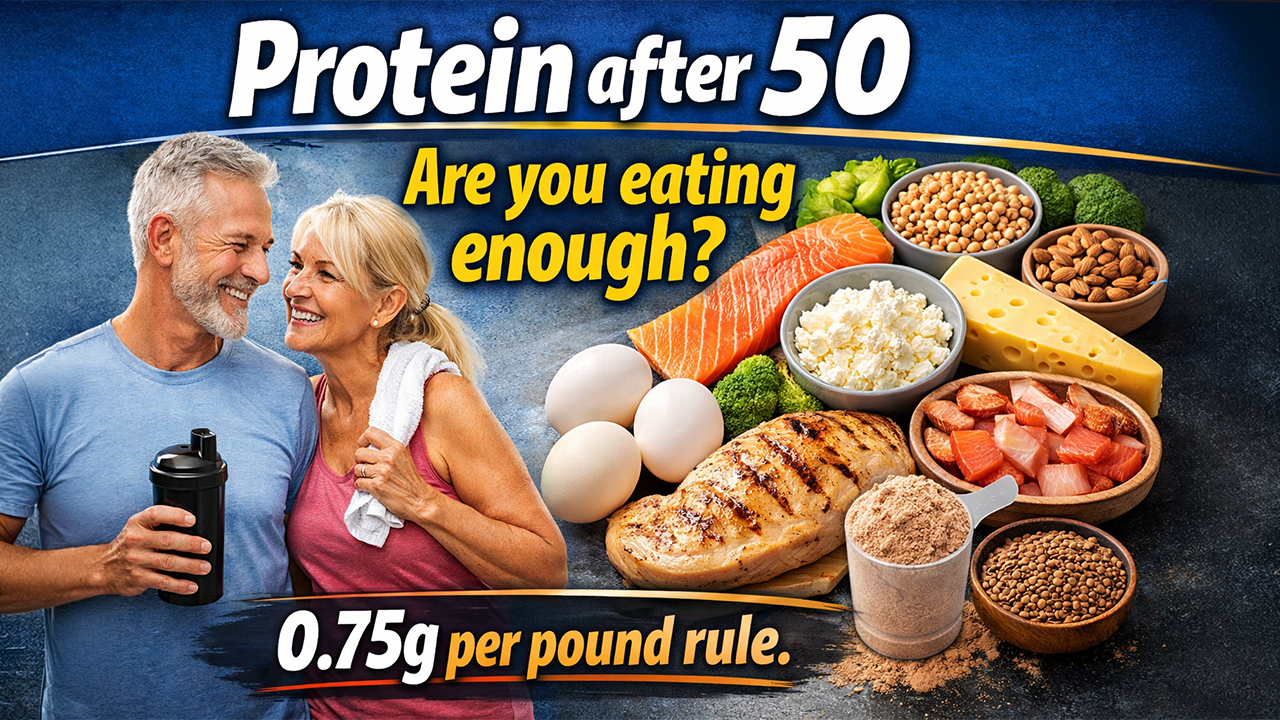
The ¾ Gram-Per-Pound Rule for Staying Strong
If you’re over 50, you may have noticed something frustrating:
🔸 Carrying groceries feels heavier.
🔸 Getting up from your couch has become a new Olympic event.
🔸 Your strength seems to be slowly disappearing with each new Presidential administration (unfortunately, you felt your strongest during Nixon).
This isn’t just “getting older.” It’s sarcopenia - the gradual loss of muscle mass that really hits the accelerator after age 50.
But wait! There’s good news! You can fight back. Hard.
Two things hold the key to a long and active life:
🔸 Strength training
🔸 Eating enough protein
Unfortunately, most people over 50 are doing half of what they should be doing with both. Let’s fix the protein part today.
⸻
Why Protein Needs Increase After 50
Most people learned the outdated government Recommended Dietary Allowance (RDA):
0.36 grams of protein per pound of body weight.
That number is enough to avoid malnutrition, but it’s not enough to stay strong, active, and independent.
After 50, your body becomes less efficient at using protein. Scientists call this:
Anabolic resistance.
Your muscles simply need more protein to trigger muscle repair and growth.
Without enough protein, things start to come off the rails. You’ll start to suffer:
🔸 muscle loss
🔸 slow metabolism
🔸 lack of strength
🔸 poor balance
🔸 higher fall risk
Not exactly the retirement plan most people had in mind.
⸻
The Simple Rule: ¾ Gram of Protein Per Pound
Forget complicated formulas.
Here’s the rule we recommend at Mindful Barbell:
Eat about ¾ gram of protein for every pound you weigh each day.
No calculators.
No kilogram conversions (I never did learn the metric system).
No nutrition PhD required.
Just multiply your weight by 0.75.
Here are some examples just in case math ain’t your thing:
150 lbs → about 110–115g protein/day
165 lbs (very common for adults) → about 120–125g protein/day
180 lbs → about 135g protein/day
This target sits slightly above most official recommendations (0.55–0.73g/lb), which is exactly where active adults over 50 tend to thrive.
If you’re strength training 2–3 times per week - which you should be - this range supports:
🔸 muscle growth
🔸 better recovery
🔸 improved strength
🔸 healthier aging
Most people who track their protein for the first time discover something shocking: They’re eating half of this amount.
⸻
Don’t Eat It All at Dinner
What’s another huge mistake people make? They eat all their protein at dinner.
Your muscles respond best when protein is spread throughout the day. For adults over 50, research suggests 25-40 grams per meal is ideal.
Here’s how I would spread it out over the day:
If you’re shooting for 120 grams a day:
Breakfast: 30–35g
Lunch: 30–35g
Dinner: 30–35g
Snacks or post-workout: 20–30g
This approach triggers muscle repair multiple times per day instead of once.
Think of it like watering a plant regularly instead of flooding it once a week.
⸻
Best Protein Sources for Adults Over 50
Not all protein is equal.
For muscle health, foods rich in leucine are especially helpful. Leucine acts like the “on switch” for muscle repair.
High-Quality Animal Proteins
Chicken breast (3 oz) — ~25g
Salmon or tuna (3 oz) — ~20–22g
Eggs (2 large) — ~12g
Greek yogurt (1 cup) — ~20–24g
Cottage cheese (½ cup) — ~14g
Whey protein powder — ~20–30g
Plant-Based Options
Lentils or chickpeas (1 cup) — ~15–18g
Tofu or tempeh (4 oz) — ~10–20g
Quinoa (1 cup) — ~8g
Almonds (¼ cup) — ~7–10g
Pea protein powder — ~20–25g
Plant proteins work well too — just combine sources to get a complete amino acid profile.
⸻
A Sample High-Protein Day (~120g)
For someone around 165 pounds.
Breakfast
Greek yogurt + berries + almonds
~28g
Snack
Hard-boiled egg + fruit
~6g
Lunch
Grilled chicken salad
~35g
Post-Workout Shake
Protein powder
~25–30g
Dinner
Salmon + quinoa + vegetables
~33g
Total: ~120–125g
Simple. No suffering required.
⸻
Easy Ways to Hit Your Protein Target
If you’re falling short, try these tricks:
🔸 Add protein to every meal and snack
🔸 Start your day with 30g at breakfast
🔸 Use protein shakes when life gets busy
🔸 Include eggs, yogurt, or cottage cheese regularly
🔸 Keep protein foods visible and convenient
The goal is consistency, not perfection.
⸻
Pair Protein with Strength Training
Protein is powerful.
But protein alone won’t save your muscles.
You also need resistance training.
At least 2–3 strength sessions per week dramatically improves muscle retention after 50.
Some excellent beginner exercises include:
- Squats or chair squats: Helps with standing, climbing stairs, and preventing falls.
- Wall push-ups: Builds chest and arm strength safely.
- Rows (bands or dumbbells): Improves posture and back strength.
- Overhead presses: Strengthens shoulders for daily tasks.
- Calf raises: Improves balance and ankle strength.
- Planks: Builds core stability and protects the spine.
Perform 2–3 sets of 10–15 reps and focus on good form.
Then give those muscles the protein they need to rebuild.
⸻
Protein + Strength Training = Aging Well
Aging doesn’t have to mean becoming fragile.
With enough protein and regular strength training, many adults in their 60s, 70s, and even 80s continue to gain strength.
The formula is simple:
Lift something challenging.
Eat enough protein.
Repeat for the next 30 years.
Your future self will thank you.
Stay connected with news and updates!
Join our mailing list to receive the latest news and updates from our team.
Don't worry, your information will not be shared.
We hate SPAM. We will never sell your information, for any reason.